
My Little Home: The Match-3 Game That Lets You Design Your Dream Space
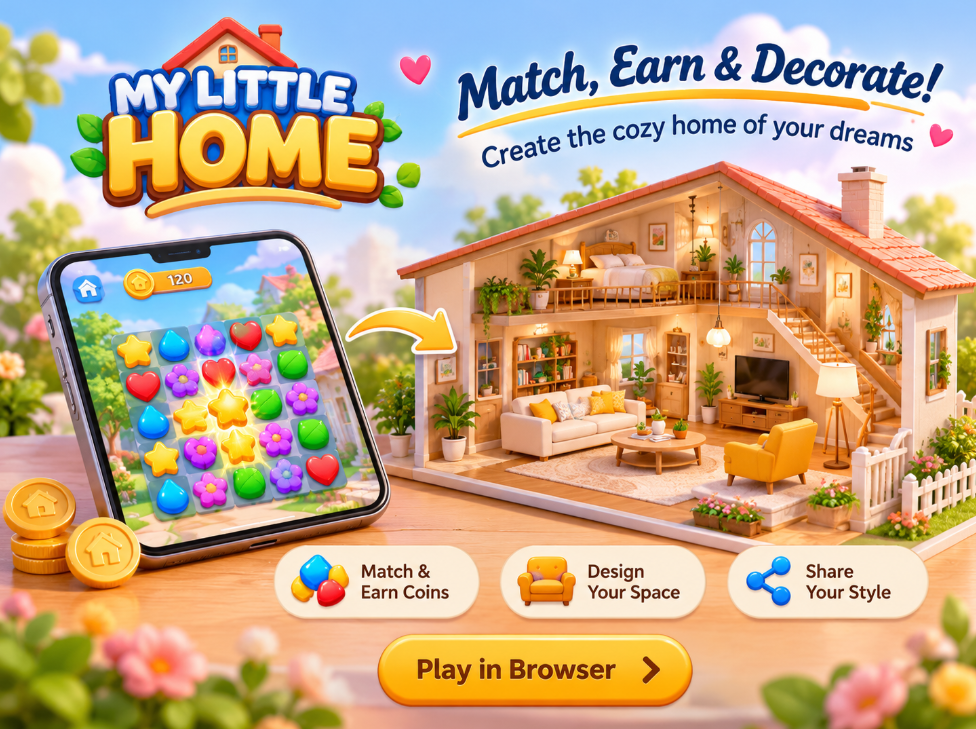
My Little Home combines match-3 puzzle gameplay with interior design. Clear levels to earn coins, then spend them on furniture to decorate your dream home in European, Japanese, or Korean styles.

Mix elimination with decoration. My Little Home combines puzzle-solving with interior design, letting you earn coins through match-3 levels and spend them on furniture to create your perfect living space.

The bedroom scene in My Little Home shows how earned furniture comes together — a cozy bed with blue and yellow accents, matching curtains, and a complete room layout that feels lived-in.
I have played my share of match-3 games. Most of them follow the same loop: match colors, clear levels, move to the next board. The formula works, but after a while it starts to feel like going through the motions.
My Little Home caught my attention because it gives those matched coins a purpose beyond a score counter. You are not just clearing levels — you are earning currency to buy furniture, decorate rooms, and slowly build a home that reflects your taste.
Two Loops That Feed Each Other
The game runs on two interconnected systems:
The match-3 loop. Colored bubbles or tiles fill the screen. You match them to clear objectives — reach a score, collect specific items, or break through obstacles within a set number of moves. It is familiar territory for anyone who has played puzzle games on their phone.
The decoration loop. Every completed level rewards you with coins. Those coins go straight into a furniture catalog where you can buy beds, sofas, lamps, rugs, curtains, and decorative pieces. Each item gets placed in your home, and the rooms gradually take shape.
What makes this work is the feedback between the two. When a level gets tough, the motivation is not just “beat the puzzle” — it is “I need 200 more coins for that dining table.” The decoration gives the puzzle loop stakes.
Three Design Styles to Explore
My Little Home offers three distinct interior aesthetics:
| Style | Vibe | Key Elements |
| European | Elegant and classic | Ornate furniture, rich fabrics, warm lighting |
| Japanese | Minimalist and clean | Low profiles, natural wood, neutral palettes |
| Korean | Warm and inviting | Soft pastels, cozy textiles, modern simplicity |
You are not locked into one style. You can mix pieces from different aesthetics or commit fully to a single theme. The game does not judge your taste — it just gives you the tools to execute it.
The Houses Are Characters Too

The house selection screen lets you choose between different properties — from a Suzhou Villa to a West Lake Villa — each with its own rooms to decorate and unlock.
Beyond individual rooms, the game frames your progress around different properties. You might start with a city apartment and eventually unlock a lakeside villa or a traditional courtyard house. Each property has multiple rooms — bedroom, kitchen, living room, study — and each room has its own furniture set to complete.
This structure gives you a sense of progression that goes beyond level numbers. You are not just “on level 47.” You are “furnishing the kitchen of the West Lake Villa.”
The Match-3 Mechanics Are Solid

The core match-3 gameplay uses colorful bubbles and clear objectives — match colors, collect items, and complete the level within the move limit.
The puzzle side of My Little Home does not reinvent the wheel, but it does not need to. The mechanics are responsive, the objectives are varied, and the difficulty curve feels fair. Some levels ask you to clear a certain score. Others require collecting specific items hidden under bubbles. A few introduce obstacles that force you to think a few moves ahead.
Power-ups and boosters are available when you get stuck, but the game does not feel predatory about them. You can earn them through play, and the levels are designed to be solvable without spending.
Community and Competition
The game includes social elements that extend the loop:
- Design tips exchange. Players can share decoration ideas and see how others styled the same rooms.
- Design competitions. Regular contests let you showcase your rooms and vote on other players’ creations.
- Room sharing. You can save and share screenshots of your finished spaces.
These features turn a single-player experience into something more communal. You are not just decorating for yourself — you are participating in a community of people who care about interior design.
Who This Is For
My Little Home sits in a niche that appeals to a few overlapping audiences:
- Match-3 fans who want their puzzle progress to mean something tangible
- Interior design enthusiasts who enjoy arranging furniture and choosing color palettes
- Casual gamers looking for a low-stress, creative outlet
- Players who like progression systems with visible results
It is not a hardcore puzzle game, and it is not a serious design simulator. It sits comfortably in the middle — a relaxed, rewarding experience that gives you a sense of accomplishment every time you place a new piece of furniture.
Final Thoughts
The best compliment I can give My Little Home is that I kept coming back to see my rooms take shape. The match-3 levels are engaging enough to pass the time, but the real hook is watching a bare apartment gradually become a fully furnished home.
There is something satisfying about that progression. A well-decorated room, earned through your own puzzle-solving, feels more personal than any pre-designed level.
What would your dream home look like? Let me know in the comments.
Play My Little Home: https://herefordhbi.com/my-little-home/




Contact Us
Newsletter
Join our community for exclusive updates, tips, and offers—subscribe today!